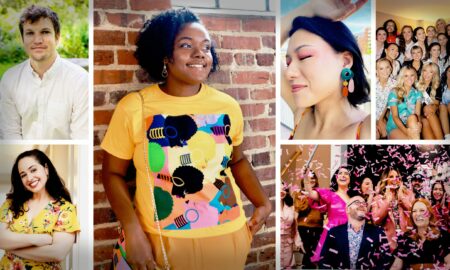





Today we’d like to introduce you to Omisade Burney-Scott.
Hi Omisade, can you start by introducing yourself? We’d love to learn more about how you got to where you are today.
I am a Black, southern, 7th generation, native North Carolinian feminist and social justice advocate. I am also a creative who has lived and worked in Durham for 30 years. Much of my life’s work has focused on the liberation of marginalized people. I have worked with and through grassroots communities, cultural organizations, philanthropy, school systems, and individuals across the South. I began my social justice activism in high school when I organized a protest against our student dress code that I thought was sexist as student body president. That was in 1985. I started working formally and professionally in the nonprofit sector in 1995. I have worked as an organizer, trainer, and advocate for nonprofits focused on racial justice, economic justice, voting rights, and reproductive justice. I have also worked as a program officer for a family foundation. Over the past 28 years, I’ve been internationally recognized as a thought leader, facilitator, and speaker at the forefront of conversations regarding Reproductive and Healing Justice; death, dying, and grief; and menopause and aging.
By 2025, over 1 billion people will experience menopause worldwide – 12% of the world population. Though menopause is critical on the Reproductive Justice spectrum, less than 30% of medical students receive substantive training. Less than 3% of OB-GYNs have expertise in menopause. This is staggering, considering the number of people who are or will be menopausal and how menopausal physiological experiences are linked to increased risks of cardiovascular disease, sleep disturbances, and changes in brain cognition and mood. I started Black Girls Guide to Surviving Menopause in 2019, during a sabbatical from movement work, to expand and normalize conversations around menopause. I intended to center all Black people–all gender identities, sexual expressions, classes, and ages. Through my work with a vibrant intergenerational team of Black women, I’ve created a space and platform that did not exist before; an ecosystem of menopausal alchemists, doulas, cartographers, and advocates.
We all face challenges, but would you describe it as a relatively smooth road?
The road has been precisely what it needed to be in service to my growth and the work I do in my community. Sometimes smooth, other times not so smooth.
Generations of Black women-identified, gender-expansive people in the U.S. have struggled to feel agency over their bodies. Since slavery, whiteness and the experiences of white people have been centered as the norm. Experiences outside of the norm are othered, marginalized, or dehumanized. Health equity, women’s health, aging, and reproductive rights for marginalized and invisibilized communities all come together in response to menopause.
At 55, the opportunities for leadership support as a Black woman seem rare. When I was in my 20s, I was considered an “emerging leader,” In my 30s and 40s, I was a mid-career activist. I was encouraged, mentored, and guided through fellowships, leadership development, and cohort peer learning opportunities that seemingly evaporated when I crossed the threshold of 50. As I move closer to 30 years of social justice work, I still have much more to offer and learn. The past four years of curating BGG2SM have allowed me to use the tools I have collected while facilitating political education training in the community. These past four years have also reanimated my creative identity, which hasn’t felt this vibrant since childhood. Being able to amplify and support the physical, mental, spiritual, and political needs of Black women-identified and gender-expansive people at the intersection of aging, gender, and race is sacred work for me.
We’ve been impressed with The Black Girl’s Guide to Surviving Menopause, but for folks who might not be as familiar, what can you share with them about what you do and what sets you apart from others?
Marginalized people are the experts of our bodies. Owning our stories is vital to having agency over our experiences, relationships, and liberation. By integrating Reproductive Justice, gender justice, and health equality, BGG2SM normalizes menopause by centering first-person narratives of those who exist at the margins of the growing menopause landscape. We nurture a community that includes all voices and lived experiences: cis, trans, intersex, queer, straight, affluent, low-wealth, activists, and creatives. Through intergenerational gatherings, strategic partnerships and collaborations, publications, and community-informed programming, BGG2SM invites people to explore the essence of menopause beyond gender, age, or societally-held frames. We focus on self-knowledge and preparation for this journey as an act of self-determination and sovereignty.
An emerging menopause industry is booming with telehealth enterprises and wellness empires. More employers are implementing menopause-friendly work policies, and menopause is now regularly covered in places like the Harvard Business Review. Congress has even introduced the bipartisan Menopause Research Act of 2022, requiring the National Institutes of Health to evaluate menopause-related research and identify further needed research. This landscape revolves primarily around high-profile cis women’s voices, realities, and influence. Leading with a gender equity ethos, I am committed to bringing my movement experience to generative partnerships. I contributed to the Black Reproductive Justice Policy Agenda published by In Our Own Voice. I contributed to a white paper on provider preparedness published by the Society for Women’s Health and Research White Paper (NAMS)). I have written extensively in byline pieces for Blavity, Ms. Magazine, and Good Housekeeping Magazine. I have been featured in media outlets such as Oprah Daily, WebMD, InStyle Magazine, and Forbes.
Since 2019, BGG2SM has built an incredible community through our cultural organizing approach. Our podcast has been streamed over 54,000 times with an average audience of 539 people per episode; it is listened to in 19 countries and is in the top 5% of podcasts streamed internationally, according to Spotify. Guests are Black community activists, creatives, artists, healers, Reproductive Justice advocates, genderqueer and trans people, doctors, and nationally recognized authors and actors. Season 4 included guests such as genderqueer trans activist and writer Austen Smith; Haitian-American queer Black feminist and social justice doula Lutze Segu; and activists and advocates Amber J. Phillips and Sonya Renee Taylor.
We have hosted nine intergenerational conversations in Washington, DC, North Carolina, Kenya, and virtually, using new dialogical tools to unpack our relationship to changing bodies, menstruation and menopause, relationships, mental health, sexual health, jobs, creativity, and bodily autonomy. BGG2SM’s goals are to seed, curate, and advocate for the normalization, exquisite care, and protection of Black people who will or have gone through their menopause journey.
We all have different ways of looking at and defining success. How do you define success?
We live in a society that tends to define success by what we own or what we produce. It doesn’t matter to me what a person does for a living, where they live, or what they own. I am more concerned or compelled by “who” a person is because everyone has a story and “how” they move. My relationships, connections, and offerings determine my success in my community and learning. I also see success as a person’s ability to be entirely free, happy, healthy, safe, and with their humanity and personhood intact.
Contact Info:
- Website: https://blackgirlsguidetosurvivingmenopause.com/
- Instagram: https://www.instagram.com/omisadeburneyscott/ and https://www.instagram.com/blackgirlsguidetomenopause/
- Facebook: https://www.facebook.com/BlackgirlsguidetoMenopause
- Other: https://podcasts.apple.com/us/podcast/black-girls-guide-to-surviving-menopause/id1462589097


Image Credits
BGG2SM “Say More” Intergenerational Gathering, Rofhiwa Book Cafe, Durham, NC (Photo credit: Denise Allen) BGG2SM Tea and Toddies Intergenerational Gathering, Calabash Tea and Tonics, Washington, DC (Photo credit: Octavius Moore) BGG2SM Team, Mariah M. Aidil Ortiz, Omisade Burney-Scott, Aja Taylor, Angel Dozier and Erika Moss, Calabash Tea and Tonics, Washington, DC (Photo credit: Octavius Moore) BGG2SM “Say More” Menopause and Midlife Discussion Deck Promo, Durham, NC (Photo credit: Derrick Beasley)