





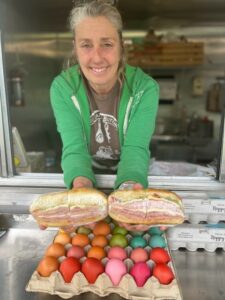
 Today we’d like to introduce you to Eliza MacLean.
Hi Eliza, we’re thrilled to have a chance to learn your story today. So, before we get into specifics, maybe you can briefly walk us through how you got to where you are today.
After spending time studying and working on issues surrounding wildlife habitat and pollution/degradation of wildlife ecosystems, I became increasingly concerned about farming practices in the southern United States in particular. The unfortunate costs associated with corporate-style agriculture to wildlife, local residents, and consumers was really coming into focus in North Carolina in the mid-nineties when I was a student at Duke School of the Environment. I was also trying to start a family at that time, and it occurred to me I could be the change I wanted to see. So, I began to think a small livestock operation could be a healthy environment to raise my own kids in and provide a way for me to be with them through their early years if I stayed home and ran the farm. My twins arrived in December 2000 and spent their first years being pulled around in wagons feeding goats, chickens, and tending to gardens as I figured out what our niche could be. The story is very colorful and is many years long now, but suffice to say, we settled on pasture-raised pigs using our sweet property’s large oak trees and grassy areas. Over the years, we have grown and shrunk in terms of how many head of goats, sheep, cows, turkeys, other poultry, and always pigs were sustainable on a property (and there have been four now), what the demand was like, and how all the ways of marketing this wholesome product could truly work. To do it well and stay in business, one must be a scientist, a mechanic, an electrician, a carpenter, and a very patient optimistic, and flexible human. It is a lifestyle that will break you down, but I am still at it because of the unwavering support I have had in the village of Saxapahaw and the whole triangle/triad area. We are still practicing rotational grazing of the different species, and happy pigs are still driving the system. These days we work our amazing products through our whole animal butcher shop. Left Bank Butchery in Saxapahaw and Alimentari at left Bank in Raleigh…
Can you talk to us a bit about the challenges and lessons you’ve learned along the way? Looking back, would you say it’s been easy or smooth in retrospect?
It has been anything but a smooth road. Farming is wonderfully collaborative at the small family farm level. Generally speaking, any kind of harvesting requires equipment and packaging and labeling, and inspection. Marketing requires more rules and hustle and finding customers that will consistently show up and purchase what you have. There are many different models to try, and sometimes we invent a new one or two that works for a while. Consistency is difficult to achieve but an important aim for the farmer/customer relationship. Many of the interactions along the path of getting product to the customer change over seasons and years, such as new owners or policies of companies we work with, from slaughter plants to greenhouses to packaging and printing to even simply a customer no longer able to afford what they used to or even closing its doors for good. In the last 25 years, all of those things have changed, many more than once, so we keep an open mind. collaborate some more, and keep going. Add our dependence on the weather as farmers, and you have a real puzzle to solve at any given time,
Alright, so let’s switch gears a bit and talk business. What should we know about your work?
I think the reason I am still raising pigs. Other livestock and vegetables and fruit behind them is the ability to teach new inquisitive minds. There is a lot of interest in managing land, raising animals, and understanding the difference between local production versus what our giant global food system has become. It has given me great pride and satisfaction to know that every single person that has worked for me at Cane Creek Farm left here with understanding and appreciation for how we run this place and to my knowledge, has remained committed (almost all, professionally in their own lives) to sustainable agriculture on some level. Much of my success has come from learning about heritage breeds and heirloom varieties that were developed over centuries and have applications now on small-scale operations. I learned from older folks ready to pass on their knowledge base and awareness of things. And I enjoy applying old and new ways of doing things and comparing notes with small-scale farmers near and far.
There are definitely people like me in farming, but if there is one thing that sets us apart from many farms, it is that I ask the question, “What more can I do for the health and well-being of my land, my animals, and my customers?” We inherently try to make things easier and do less, but in terms of this farm, I have tried to do all I can to not cut corners. Simplify, yes. So, we have the energy to keep going, but I really try to keep things growing to their full potential.
What were you like growing up?
I was a bit wild growing up. My playground was the vast and beautiful St Lawrence River… I liked extremes. Super-hot weather. Super cold. I wanted to compete in endurance sports and did for a good while. I was down to try almost anything adventurous and self-propelled–biking, running, kayaking long distances. I still do those things, and I love live music and dancing with friends.
We traveled by car a lot as a family, and I was always enamored with farms and the beautiful way they were so individual, as if the land the people were stewarding showed them how to tend it. It was not until those years at Duke that I felt compelled to try to farm myself, but it makes sense after all the looking at land, and we are now on a beautiful century farm, one that was in the same family for over 100 years. I am running it much like it was when the land was first chosen to yield food for its community and that feels good.
Contact Info:
- Website: canecreekfarm.us, leftbankbutchery.com


Image Credits
Eliza MacLean