




Today we’d like to introduce you to Nicole Connelly.
Hi Nicole, so excited to have you on the platform. So before we get into questions about your work-life, maybe you can bring our readers up to speed on your story and how you got to where you are today?
I started dreaming about Toad Hill Farm in 2014 a year after my daughter was born as a response to a number of drivers including a deeply seated love of biology and a desire to be active and useful in my community – Farming started to line up against a set of things that I felt deeply concerned and intermittently powerless and motivated about including climate change, loss of biodiversity, the destructive role of ‘big ag’ and the loss of local food sovereignty.
Over the course of the next few years, I started reading books by Gene Logsdon and Wendel Berry amongst many others, I joined local community organizations in food security (DFFN, End Hunger Durham, Plant a Row – all of which have evolved, but versions of which still exist), and began volunteering at local gardens and Farms (IFFN Geer Street Learning Garden, Funny Girl Farm, Hurtgen Meadows), I joined the Durham County Farmland Protection Advisory Board, started attending the CFSA annual Sustainable Agriculture Conference, went on every local farm tour available (there are so many great small sustainable farms in our area) and took classes through the NC Extension in Durham and Orange County. It was at this point that I brought my husband on path and we took an intensive multi-month course through the NC Extension that laid out very real steps to operationalize a small sustainable agriculture endeavor.
We worked with a local realtor and after many months of searching, in 2017 we were able to find a property with space for a market garden, and potential for expansion (orchard? small grazing herd?) in Northern Durham. In early 2018 we broke ground with a rototiller gifted from my father-in-law (who has been part of the farm team from this point forward) and a few passes with a garden tractor with a plow attachment when a farm friend took pity on our plight with the sod…. that April, we joined a small local Farmer’s Market (the Roots Market – no longer active, but always in my heart) with one small table, 2 bunches of radishes, 2 heads of lettuce, a bunch of kale, and all the smiles and nerves and adrenaline our little family could muster.
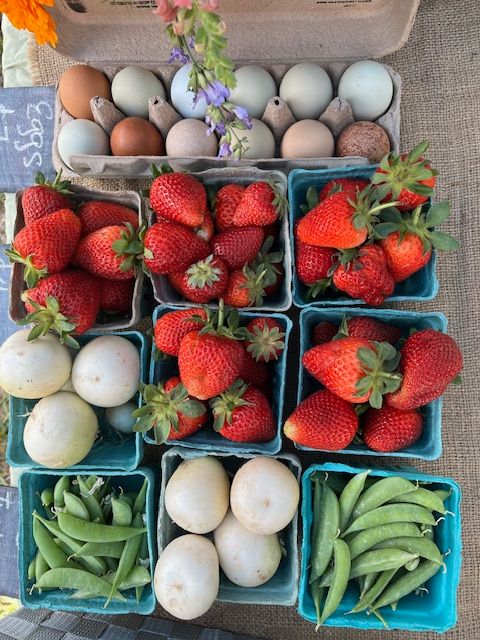
Today, we are still going with a still small, community-oriented vegetable, flower, fruit, egg and clay enterprise and are marketing out of the North Durham Farmer’s Market as well as online sales for weekly pickup. We focus on growing ‘real’ food that is suited to our growing climate. I am intermittently obsessed with peas, collards, potatoes, mulberries, corn (dried for nixtamal and masa), okra, eggplant, apples, southern peas and winter squash. We eat what we grow – and we grow with organic practices, keeping inputs to a minimum (organic fertilizer sources – on farm if possible; MINIMAL spot use of organic pesticides only when necessary), and leveraging lots of farm sourced mulches and cover crops to constantly work on our soil. We have been planting fruit and nut trees with a focus on native species with a goal of evolving toward perennial crops as we go. Our Farm motto is “growing healthy food for our community using toad friendly practices”.
In addition to the food, we have found it very rewarding to grow no-spray flowers for our market as well and have flower rows interspersed with our food crops which we think drives a more integrated ecosystem. We have also leaned even further into the art of our ecosystem with the addition of clay work to the operation: I have taken pottery classes on and off for 20 years, and Durham has a vibrant clay community that I am so grateful for. As I dug and grew and periodically failed in the garden – the Durham County red clay was ever-present and persistent. I finally confirmed what I suspected when I was able to take a class with Katie King (Waxing Gibbous), and have been digging and working our local clay, making farm inspired clay creations to sell alongside our veggies and flowers at the farmers market since 2023.
I’m sure it wasn’t obstacle-free, but would you say the journey has been fairly smooth so far?
It has been a smooth road in the sense that I think it’s miraculous that we have been able to do this. It is something that has to fit in against our non-farm jobs and raising our family. We have been able to build it in a flexible way, but with all long days. Some of the days have been really frustrating, many have been weird, lots of them have been frantic, but it has also been a steady focus and muse and place to put our hands and community to connect to and seasons to ground us as we have made our way through pandemics, and weird politics, and pre-teens, and family illnesses and transitions.
One of the main struggles we have always come back to is finding enough hours in the day. Finding the right property was a challenge – but we were VERY lucky to have a house to sell to be able to get out to the county (of all of the struggles in farming, one of the most critical is getting folks access to land, space and infrastructure – once farmland transitions out of farming, it is nearly impossible to get it back). Learning and implementing small business structures (risk-management, business structure and accounting, taxes). Learning what to grow, where and how to grow it, and who else was going to want to eat it (both in the market, but also pests…. so many pests just waiting for their exact crop to be planted…) was a big curve. Balancing presence is a big one.
And through it all, getting the balance of growing enough of the right things and getting them to the right people through the right channels is a struggle – we are a very small operation, and do not have the scale to go to some of the larger markets, and we have been VERY lucky and grateful to have had small, community-connected markets as options. We also are very grateful for a customer base that shops online with us and picks up pre-orders at our market spots each week. But it is always a challenge to find the best model to get our products to our community and to make the economics work – we strive to make our foods and flowers a healthy and locally accessible and affordable alternative to grocery stores – but when affordability becomes an issue, and SNAP and matching programs are threatened, many customers stop coming to farmers markets to buy their food.
Thanks for sharing that. So, maybe next you can tell us a bit more about your work?
We have grown to have three key focuses on Toad Hill Farm (other than tracking the where-abouts of, and protecting toads):
*Vegetables/Fruits – we have always gravitated to the magic of growing ‘real food’ sustainably. And for us in North Carolina, that also means focusing on the right crops – my philosophy has been to put the effort in to grow good food for our community -but not to try to bend the rules too far, and not to wind ourselves up catering to princess crops – I LOVE a crop that deals with heat and clay (and drought and flood) and that I can evade the pests (with rotation, and timing versus chemicals) and put real food on the table: strawberries, potatoes, kale/collards, beets, beans, cucumbers, okra, eggplants, dent corn, apples, winter squash. We are building out our perennial game (native fruit and nut orchard), and TRYING every year to focus on the right annuals.
*Flowers – we have a mix of perennial and annual flowers in three or four spots in the garden and a third of what we do each week is finding what’s blooming and assembling rollicking farmers bouquets. These are all no spray, and we always try and mix fragrant herbs in each bunch. We also save seeds from a number of the key varieties and we dry flowers for dried bunches, holiday wreaths and wall hangings.
*Clay – Wheel-thrown pottery has been a newer, but critical addition to the farm. I have been on a journey with our farm-dug clay – it is a mix of prospecting, analytical chemistry, and witchcraft and has allowed us to focus on both decorative and functional ware with our clay. Some days it slows my farming down a lot as I get distracted by lumps of clay, or interesting rocks (are you for glaze?), or plant debris (are your ashes for glaze?), or pretty flowers or cute radishes (are you for painting on a pot?). In one of my favorite developments, in the past two years our resident groundhog has dug the BEST batches of farm clay yet (Ground Hog Red). I also throw commercial clays, but I do a lot of surface decoration (often with THF slip) and the themes almost always wander back to the garden.
Are there any important lessons you’ve learned that you can share with us?
The answer is somewhere in the balance of flexibility and consistency and perspective. Sustainability for our environment, and our family is a constant juggling act. Staying connected and useful to our community is a constant juggling act. Remembering what it’s for and balancing the farm versus other obligations and goals and presence on a day to day basis is a constant juggling act. I have needed to learn that it’s a long game and we’re going to win some, and lose some, and sometimes you just have to let the bean row go.
Contact Info:
- Website: https://toadhillfarm.com
- Instagram: @toadhillfarmnc