



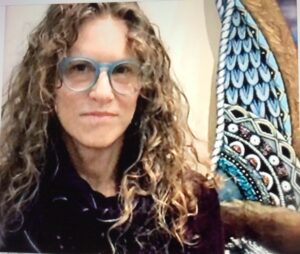
Today we’d like to introduce you to Sudie Rakusin.
Hi Sudie, thanks for sharing your story with us. To start, maybe you can tell our readers some of your backstories.
I was born an artist. It was the one sure thing in my life. I was the ‘artist’ in every grade and classroom, the one asked to draw or paint the poster, etc. My mother used to say, when I needed clarity on a question, I would say, “draw me a picture.”
This was my first language. I got my BFA in painting at Boston University and my MFA in Painting at the University of Arizona. If there is ever a choice of activity I will choose to be in my studio with my work and my dogs.
Art has been my refuge and safe place. It is where I go to clear my head, for solace, for reassurance, and to be reminded there is still beauty and joy in a confusing world. Color, pattern, and light make my heart beat faster.
Alright, so let’s dig a little deeper into the story – has it been an easy path overall, and if not, what were the challenges you’ve had to overcome?
I have never experienced ‘a smooth road’. I was considered ‘the best artist’ in school until I went to college where I attended with all ‘the best artists’. I would say, I was average compared to others so I had to work really hard. I also was in college in the ’60s when the idea of feminism and some sort of equality was just beginning. Boston University was extremely old school.
The professors, all-male, wore long grey coats over their white shirts and ties and paid very little attention to the female students, assuming they would finish college, get married and pregnant, and never do art again. I decided to sign my work ‘S. Rakusin’ so they wouldn’t know my gender! There were only two professors that paid any attention to my work at Boston University. I always said I did my art not because of support and encouragement, but, despite of it. It wasn’t until graduate school, at the University of Arizona, that an art history professor saw my potential and championed me. I will always be grateful to him.
Another barrier is that my work has never been mainstream. I was blessed with a vivid imagination, and I like to work in a multitude of mediums. I love color and I love pen and ink. I love to paint and I love to sculpt. My feminism deepened and grew and evolved into considering that the oppression and inequality was not only of women but also included the abuse and neglect of animals and the earth. I love animals, consider them kin and they permeate my art. My work doesn’t fit into any category and it isn’t for everyone, but, those that do appreciate my work are moved by it.
If I could have been a production potter or chosen landscapes as my subject my road would have been much smoother, but, I paint, draw and sculpt what I love and what sustains me.
Can you tell our readers more about what you do and what you think sets you apart from others?
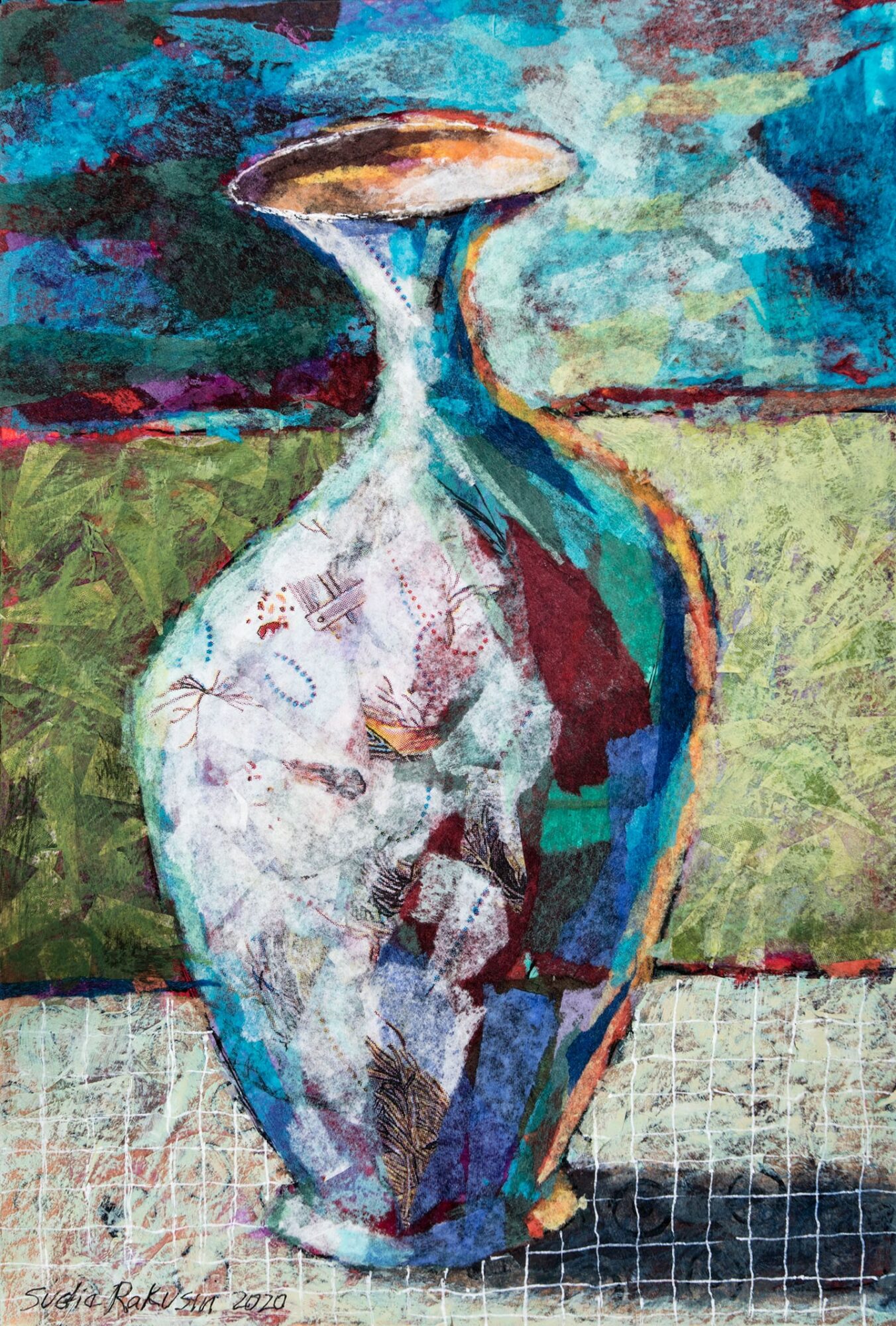
I paint in oils, acrylic, draw in pen and ink and sculpt in papier-mache. Since 2016, I have been exploring abstracts in cold wax and oils. I have written, illustrated, and published three children’s books about my Great Dane, coloring books for women, a deck of divination cards, and many notecard packs of reproductions of my paintings.
I don’t specialize in any one thing because I am always challenging myself to try something I’ve never done before. Maybe that’s what I’m known for! I love this quote from Diane Sawyer, ‘I wake up curious every morning’. My work flows from what moves me and where I find beauty; women, animals, the earth, color, pattern, and light. Through my work I am envisioning and creating the world as I would like it to be; a place where harmony is present between animals and humans.
I stopped painting on canvas for a number of years. When I decided I wanted to go back to the canvas, I knew it wouldn’t ‘look’ like my earlier paintings. In 2008, I experimented with this inkling of an idea to combine all the elements I loved into one piece; raised surfaces, papier mache, beads, ribbon, lace, found objects, and lights. Once I gave myself permission to pierce the canvas, anything was possible. I started sculpting bas relief birds and flowers and covering them with beads. I adorned my women and animals with necklaces and bracelets. I added shelves, drawers, windows, LED lights, etc.
I make papier mache birds that hang from fishing line and 4 legged creatures that stand firmly on the ground, large wall-hanging poppy flowers, and vessels. In 2016, the word altar came into my head. I wrote it down in my sketchbook and began thinking about what an altar looks like. It has hinged doors that open up onto a painting. I saw the doors covered in an abstract painting. Up to this point I had not painted an abstract. So, I did some research, made a list of supplies and bought palette knives, cold wax, wood panels, and started exploring this world. It’s still a challenge and I have a ‘love/hate’ relationship with cold wax and oils, but, I’m grateful it holds my attention.
I am proud of the work ethic that I learned from my father. I work all the time. Although, truthfully, this is who I am, and during the hardest times in my life my art has saved me. If I have it I will get through anything.
I think what I am known for are the multiple mediums I use, my staunch feminism and fight for justice, my love, kinship, and deep connection to the earth and her animals.
Do you have any advice for those just starting out?
One piece of advice I always offer is to keep a sketchbook with you at all times. Draw everything. Use your sketchbook to journal too. Write down ideas, observations, color combinations, collect quotes. Your eyes and your hands are your greatest tools. Hone them. Study and learn from the masters. Copy them.
Don’t be in a hurry to find your ‘style’. Early Picasso looked exactly like Degas! Your style will evolve organically. Take classes. You are born with an imagination that no one can take from you. Learn the skills of drawing, painting, anatomy, perspective, design, color. This way you will be adept at manifesting your ideas and vision.
Selling is not an indication you are a good artist.
When I was first submitting my work to shows and publications I would be crushed if rejected. Eventually, I came to understand that each show, magazine, newsletter has jurors that have opinions and styles. That they did not choose my work was their opinion and not a reflection on the quality of my work. Submitting your work is brave and a risk. You will be rejected as many if not more times than your work is accepted. It’s part of the landscape. Please don’t let this discourage you. Keep doing your work because you love to and it nourishes you.
Contact Info:
- Email: [email protected]
- Website: sudierakusin.com
- Instagram: @sudie.rakusin