


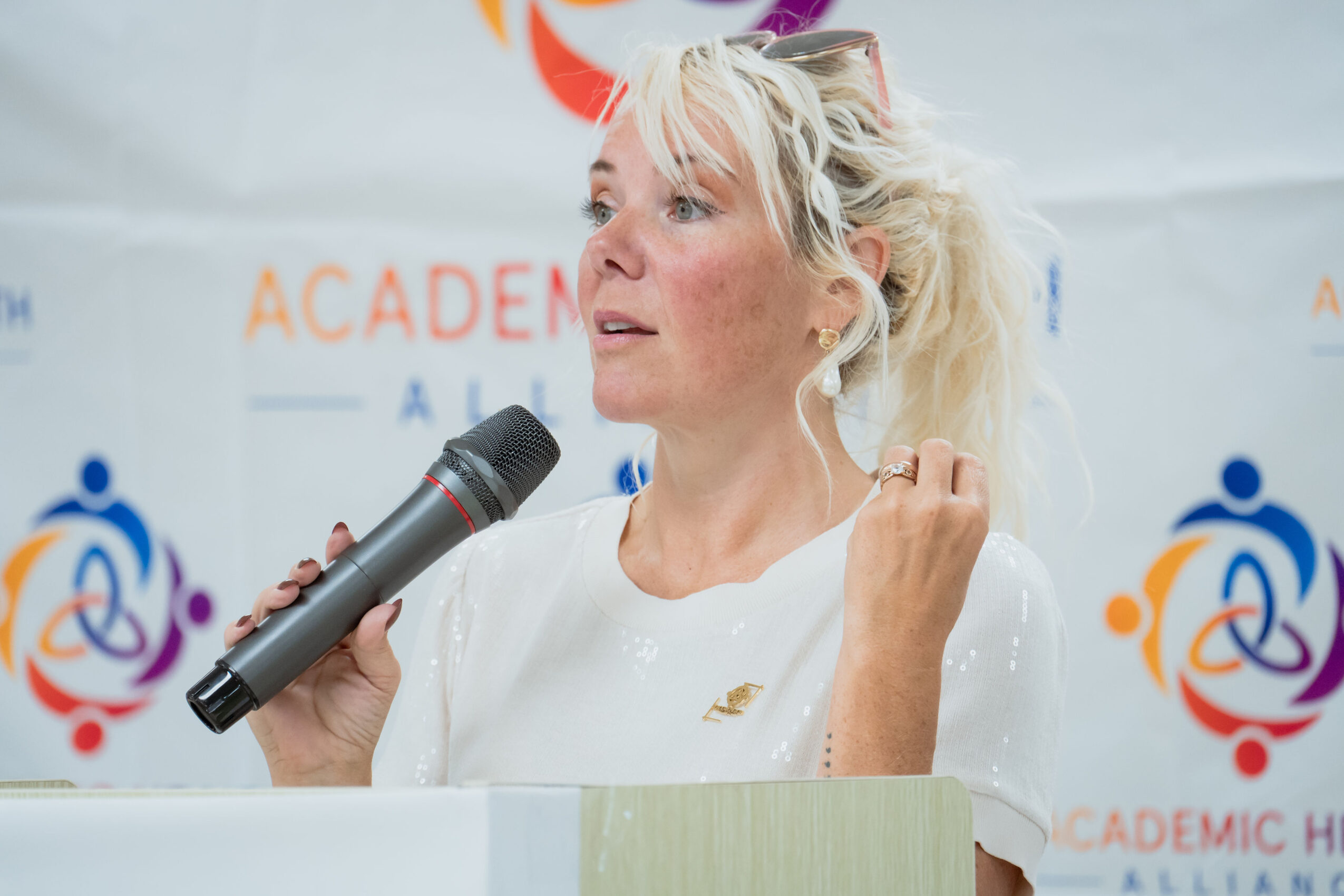
Today we’d like to introduce you to Kelcie Lynch.
Kelcie, we appreciate you taking the time to share your story with us today. Where does your story begin?
My journey to Academic Health Alliance really started at home, as a mother.
I’m a mother of three boys, all of whom are neurodivergent. Two of my sons have autism and ADHD, and one has ADHD. Like so many parents, when we first started navigating diagnoses, I found myself overwhelmed, searching for answers, and trying to understand how to best support my children. There was so much information available, but finding practical, understandable resources that translated research and professional knowledge into everyday life was a completely different challenge.
I spent a lot of time feeling like I was supposed to somehow figure everything out on my own. I wanted to understand my children better, communicate with them better, and help them thrive without constantly feeling like I was trying to make them fit into a world that wasn’t designed for how they experienced it.
Along that journey, I also began recognizing things about myself. I eventually discovered that I, too, am autistic. Looking back, so many things about my life, the way I think, the way I problem-solve, and the way I approach challenges suddenly made more sense.
What started as a personal search for answers eventually became a much bigger vision. I realized that families didn’t just need more information. They needed information they could actually use. They needed resources that made complex research understandable, tools they could implement at home, and support that recognized the entire family, not just the diagnosis.
That is really where Academic Health Alliance was born.
Our vision became bridging the gap between academic research and real-life application. We wanted to take what we know from research, education, and professional expertise and translate it into practical resources for families, caregivers, educators, and the neurodivergent community.
Today, as COO of Academic Health Alliance, I get to help turn that vision into something tangible. We develop educational resources, media, master classes, and practical tools that help people better understand neurodivergence, communication, behavior, sensory needs, and functional outcomes.
One of the things I’m most passionate about is changing the conversation around neurodivergence. Instead of constantly asking how we can change an individual to fit the world around them, I want us to ask how we can better understand them, support their strengths, and create environments where they can thrive.
What began as one mother’s search for answers has grown into an organization that has touched more than 32,000 families.
I think that’s what makes this work so meaningful to me. I’m not approaching this solely from an organizational or business perspective. I’ve lived the experience on the family side. I understand the frustration of searching for answers, the feeling of being overwhelmed, and the difference it makes when someone finally gives you information that actually helps.
I didn’t set out to build an organization. I set out to find better answers for my family. Somewhere along the way, I realized we could help thousands of other families find theirs, too.
Can you talk to us a bit about the challenges and lessons you’ve learned along the way. Looking back would you say it’s been easy or smooth in retrospect?
No, it definitely hasn’t been a smooth road. Honestly, I think one of our biggest challenges is cutting through all the noise online and reaching the families who actually need us.
When I’m out in the community and I see a mother struggling, I can walk over, start a conversation, offer some understanding, and let her know she’s not alone. There’s something powerful about that face-to-face connection. You can see when someone needs reassurance, and sometimes just knowing another person understands can make all the difference.
But translating that same connection to the online world is much harder. Families are inundated with information, advice, products, opinions, and sometimes conflicting recommendations. It’s difficult to know who to trust, where to start, or what might actually help.
Another challenge is that no two families are at the same stage in their journey. One parent may have just received a diagnosis and be trying to understand what autism or ADHD means for their child. Another may have been navigating it for ten years and be looking for help with sensory regulation, communication, education, or independence.
Even the resources that work are different for every individual. Maybe weighted clothing didn’t work for one family, but it could be exactly what another child needs. That doesn’t mean the resource was bad; it means our children and their needs are different.
That’s actually something I would love to see Academic Health Alliance grow into: a centralized hub where families can find reliable, practical resources based on where they are in their journey. Imagine a parent being able to come to one place, identify what they’re struggling with, and find relevant educational materials, tools, products, and resources without having to spend countless hours searching the internet.
I would also love to build a stronger community where families can share what has worked, what hasn’t, and what they’ve learned along the way. Sometimes the most valuable information comes from another parent who has already walked a similar path.
I think one of the biggest lessons I’ve learned is that having great resources isn’t enough. We have to make sure families can actually find them, understand them, and know how to use them.
That’s the challenge, but it’s also what motivates me. I don’t want families to feel like they have to reinvent the wheel every time they encounter a new challenge. I want them to have somewhere to turn, someone who understands, and a starting point that makes the journey feel a little less overwhelming.
As you know, we’re big fans of you and your work. For our readers who might not be as familiar what can you tell them about what you do?
Funny enough, when people ask me what I do for a living, I usually just smile and say, “Yes.” Because the truth is, I do a little bit of everything!
I’ve never been someone who fits neatly into one job title. My professional background spans nonprofit leadership, grant writing, business development, aquaculture, horticulture, healthcare, luxury real estate, and the creative arts. I’m a published author and have commissioned artists for creative and community projects. I’m the founder of Academic Health Alliance, serve as COO, work alongside nonprofit organizations in California, and am involved in hospital and community initiatives. I’m also the Executive Vice President of the Jaycees, sit on four boards and two councils, and somehow manage to be a mother of three homeschooled boys in the middle of it all.
But if I had to describe what I really do, I’d say I’m a serial volunteer. I have a hard time seeing a need and walking away when I know I might be able to help. Sometimes that means writing a grant, sometimes it means connecting someone with the right resource, sometimes it means helping an organization build something from the ground up, and sometimes it simply means showing up for someone who needs support.
A few years ago, I was struck by lightning, and that experience changed my perspective on life in a pretty profound way. In that moment, I genuinely thought I was going to die. When I reflected on my life afterward, something really stood out to me: Not once did I think, “Man, I helped too many people.” I didn’t regret the time I had given, the organizations I had supported, or the people I had shown up for. If anything, it reinforced that I wanted to do more with the time I had.
That experience helped me get really clear about what matters to me. I want my three boys to grow up understanding that helping people isn’t something you do when it’s convenient or when you have extra time. It’s part of being a good human being. You don’t have to be wealthy, have an impressive title, or run an organization to make a difference. You just have to be willing to help.
I believe that’s what makes strong communities. It’s people showing up for one another, sharing what they know, using whatever resources they have, and recognizing that even the smallest contribution can have a lasting impact.
My career has taken me in a lot of different directions, and I honestly don’t know that I’m finished exploring any of them. But there’s a common thread through everything I do: I love building things, connecting people, solving problems, and finding ways to make a difference.
So, when someone asks me what I do, I still think “yes” is probably the most accurate answer. Because whatever the need is, if I can help, I’ll find a way to show up.
Can you talk to us a bit about the role of luck?
I am lucky enough to know that kindness is free and that is the most powerful magic there is.
Contact Info:
- Website: https://www.academichealthalliance.com
- Instagram: https://www.instagram.com/academichealthalliance/
- Facebook: https://www.facebook.com/profile.php?id=61586691418467
- Youtube: https://www.youtube.com/@AcademicHealthAlliance
Image Credits
Simply Captured