



Today we’d like to introduce you to Falani Spivey.
Hi Falani, we’re thrilled to have a chance to learn your story today. So, before we get into specifics, maybe you can briefly walk us through how you got to where you are today?
My name is Falani Afrika Spivey. I was named after the Fulani, the largest nomadic tribe in the world, who migrated from Ethiopia across the Sahel to West Africa. I was born in Washington, DC and raised between Chocolate City and the countryside of North Carolina. The block I grew up on consisted mainly of Carolinians who went north during the Great Migration. I was immersed in the best of both worlds: a black metropolis with southern charm and family farms in Franklin County, NC.
For as long as I can remember, I’ve always had a connection to the loamy soils of eastern Carolina. Some of my first memories in life were playing in the soil at my great-grandparents’ home in Bunn. We’d dig up worms to give to my Daddy for fishing bait. I also have fond recollections of my Grandpa’s farm field where he’d grow watermelons, cantaloupes, yellow squash, field peas, cabbage, collards, and sweet potatoes. There were also fruit trees where we’d pick apples, plums, peaches, and pecans. My Grandma was an exotic flower grower who preferred tending to her multiple flower beds and rose bushes in the yard. These weren’t just activities—they were my initiation into understanding the land, the patterns of growing, and the different ways people can be in relationship with the earth.
I didn’t choose farming; farming had already chosen me, woven into my earliest memories and the legacy carried in my very name.
Would you say it’s been a smooth road, and if not what are some of the biggest challenges you’ve faced along the way?
I started growing my own food in 2015 after a battle with depression and anxiety. My father encouraged me to get into nature, get my hands in the soil, ground my bare feet on the earth, and grow my own food to heal myself. My journey started as a coping mechanism, and I fell in love with gardening. At the time, I lived in an urban setting and had a 10×15-foot plot in a community garden. What started out as a lifestyle hobby became a business during the pandemic when people wanted to eat healthier and began inquiring about purchasing fresh produce. For two years, I became a nomadic gardener with three different plots to provide for the demand of customers. Then I joined an urban farm incubator in Maryland and started raising seeded watermelons and peppers on a half-acre plot.
It was then that I realized farming in America for Black folks still holds the same racial constructs of slavery. I was leasing the farm plot on a former plantation, and the main organization running it had no cultural knowledge of how to work with farmers of color. The setup of having a young white farm manager who was very invasive in his approach to managing the farm was reminiscent of an overseer on a plantation. Many farmers leasing plots shared the same sentiments about the construct of the farm incubator. We started out attempting to organize and bring our grievances to the stakeholders of the project. However, I was left to address everything on my own due to harassment and retaliation from the organization’s leader. It was a very harsh environment to run my farm business and to host customers.
It was then I decided that urban farming wasn’t for me, as it seemed like modern-day sharecropping. White-led organizations get grants to run farms, put farmers on land to work the farm with no start-up fund support, and then after you work and enrich the soil, you’re kicked off. I made the decision to come back home to family land where I was welcomed and to revive my great-grandparents’ heritage farm in Louisburg, NC.
I came down home to farm but have been experiencing financial challenges with reviving and operating the farm. Although we have retained the farmland in the family, it comes with challenges on how we will maintain it moving forward as developers hawk the land and family members feud over how to conduct business for the legacy to expand into modern times. One of my biggest challenges is securing the financing to purchase the farm from family members so that I can run an operational farm and build a value-added facility to make products on the farm. Purchasing the farm isn’t just about my business—it’s about ensuring this land remains in the family and doesn’t get sold to developers who would erase generations of our history and connection to this soil.
Thanks – so what else should our readers know about Byrd’s Nest Box?
Byrd’s Nest Box is a heritage farm company inspired by my agrarian lineage and the legacy of those who built America. My nickname is Byrd, so I named the company to reflect what my family affectionately calls me. I travel to Africa and throughout the diaspora to study the foodways that Black folks have retained from the continent through the Atlantic trade of enslaved Africans. I grow crops that have been staples in our diets for generations—seeded watermelons, okra, field peas, and peppers. Our heritage farm has fruit trees planted by my great-grandmother about 75 years ago, and when I tend them, I’m tending her memory and vision.
What sets us apart is our commitment to preserving and celebrating African diasporic food traditions. We’re not just farming; we’re reclaiming and continuing foodways that carry centuries of knowledge, resilience, and culture. I’m most proud that Byrd’s Nest Box stands as a testament to Black agricultural heritage and family legacy. We currently offer fresh heritage produce, our hot sauce collection, jellies, a limited variety of heritage seeds saved from our farm, and workshops throughout the season. I’m expanding the business to include more value-added products made right here on the land.
We are a family-operated business that seeks to inspire other families with farmland to activate their land and grow sustainable foods for their families and communities. Our mission is to show that heritage farming isn’t just about the past—it’s about building a sustainable, culturally grounded future.
Where we are in life is often partly because of others. Who/what else deserves credit for how your story turned out?
I am deeply grateful to be born a Spivey and to revive my great-grandparents’ farmland as the center of our family legacy. Though Grandpa Charlie and Grandma Ellen passed away before I was born, their farm enterprise and land ownership made it possible for me to return to land that has been home to five generations. My paternal grandparents were the last to expose my generation to homesteading and farming. During their final years, they allowed me to garden a small plot on their farm where I grew vegetable crops and cooked homestead meals for them—a gift I will always treasure.
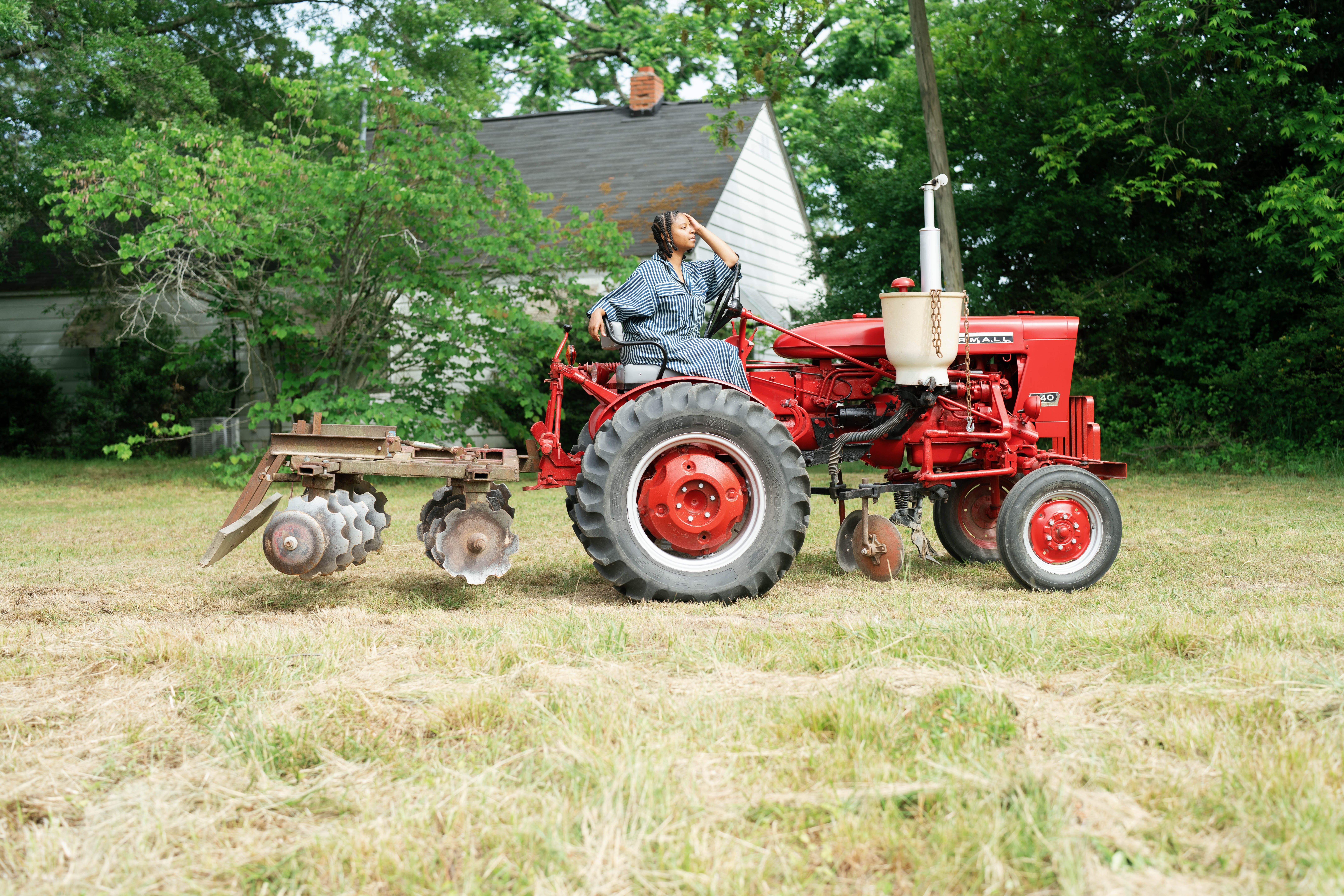
My father deserves immense credit for encouraging me to grow my own food 11 years ago. He’s now my business partner and works the farm alongside me. He taught me to drive my 1974 Farmall 160 tractor in a 15-minute crash course—I’d never driven a stick shift before, but with my Daddy’s encouragement, I learned I could do anything. My mother has been equally essential, working alongside me in the kitchen to create our value-added products with care and precision. My sister assists me with administrative tasks and website design, my nephew and cousin work as farmhands, and my nieces help me sow seeds. We are truly a family-operated business, carrying on the tradition of how my great-grandparents farmed this land.
About two years ago, I attended a protest organized by Acres of Ancestry and met Black legacy farmers from across North Carolina who have generously shared their knowledge with me. Mr. Vern Switzer, a legendary watermelon farmer and author from Rural Hall, NC, taught me the art of growing watermelons. Acres of Ancestry has also supported my farm with event sponsorships.
I’m grateful for my partnership with Charismatic Creations, a DC hospitality agency. Together we create non-alcoholic mixers using fresh fruits and botanical herbs from the farm. And I’m thankful for the community of customers, friends and family members who have supported my pop-ups and on-farm events for the past six years.
Pricing:
- Hot Sauces $10-$20
- Hot Pepper Jellies $10-$20
- Seeded Watermelons $10-$20
Contact Info:
- Website: https://www.byrdsnestbox.co
- Instagram: https://www.instagram.com/byrdsnestbox/?hl=en
- Facebook: https://www.facebook.com/profile.php?id=61581355461137


Image Credits
All photos were taken by Ayanah George