



Today we’d like to introduce you to Roni Nicole.
Hi Roni, we’re thrilled to have a chance to learn your story today. So, before we get into specifics, maybe you can briefly walk us through how you got to where you are today.
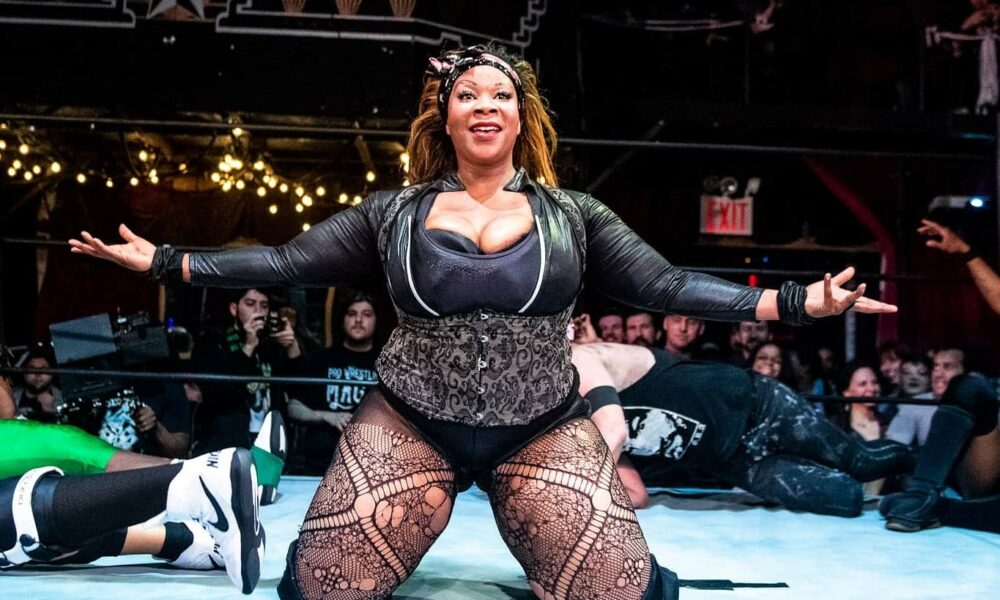
I started in entertainment at a very young age, and performing in the church helped remove much of that stage fright growing up. As I grew from the choir and lyrical dance to cheerleading, ballet, pageants, plays, and the Arts, etc., I was captivated by performance art or some other artistic endeavor from that point forward. Therefore, becoming a Professional Wrestler culminates my artistic passions into one beautiful, brutal art. Initially did not know how to become a Professional Wrestler, and at the time, in the early 2010s, there were few locally available schools in this area. I had to piece together my Professional Wrestling training through small-town training schools in Fayetteville and Wilson Mills. I was fortunate to spend 4 years living, training, and wrestling in Japan, which added to the strength of my skills. After touring Internationally, Japan, China, Nigeria, Mexico, and the Philippines. I began to notice that Professional Wrestling needed more protections for its performers, especially those of the BIPOC and LGBTQIA+ communities. As an activist and Cultural Arts Director, it was natural that work bled into my wrestling career. I pivoted into the entertainment advocacy space to help improve Professional Wrestling on the local and international levels. Many people are familiar with larger companies such as WWE or AEW Wrestling. However, the Carolinas has a rich wrestling history, and Raleigh is home to numerous Professional Wrestling companies that help wrestlers build their skills and entertain the community locally and internationally. Professional wrestling is a beautiful art I enjoy sharing with the world, and I feel very fortunate to have trained and wrestled in over 13 countries; even more blessed to continue to pursue this dream after 10 years.
Can you talk to us about the challenges and lessons you’ve learned along the way? Would you say it’s been easy or smooth in retrospect?
The road has not been smooth and has been fraught with many challenges. These are lessons that I now gratefully reflect upon. However, Professional Wrestling has a less appealing side that needs rehabilitation, and some overtly toxic racism and misogyny that has carried over from a bygone era still permeate today. Being a Plus-Sized Queer Afro-Latina in the South, often in my early year, racial issues would find their way into locker rooms or offices where Professional Wrestling businesses were being conducted. If you are outspoken and seek to advocate for respect and safety in working environments, it would sometimes “disrupt” the status quo of toxic ideals practiced by certain companies within the industry. Sizeism and fat phobia also plague the Professional Wrestling industry; I’ve often faced these in ways that would be uncomfortable for individuals who are “straight size” and aren’t familiar with those types of body challenges. Unkind words and refusals of work based on size aesthetics have been challenges I have faced and continue to face throughout my career. It has always been my goal, however, to face these challenges with grace and aplomb because each challenge presents a unique opportunity to learn, grow, educate and advocate, ultimately changing Professional Wrestling for the better.
Please tell our readers more about what you do and what you think sets you apart from others.
I am most proud of my international professional wrestling career and how it has been able to help others after me. As an Afro-Latina, many others could tour and travel internationally because of the precedent I was able to set, being offered the opportunity to train and wrestle in all of these countries. There were many Black, Indigenous, Latin, and Afro-Latin wrestlers historically. However, their stories were often overlooked, white-washed, or lost to history. The records we were able to find have mixed resolutions to them. Often, the stories from previous decades needed better resolutions. However, wrestlers like myself are a part of a new legacy that changes how wrestlers of color are received internationally and at home. I am truly grateful for and proud of being able to open up the international community to 2 more individuals of color and carry on the legacy of my wrestling ancestors.
Risk-taking is a topic that people have widely differing views on – we’d love to hear your thoughts.
I genuinely believe in risk and reward. The risk is more of an instinct in the moment’s stillness. I am guided and choose whether or not to “jump.” Risk is important. It can be a catalyst for change, and new things blossom and grow upon that change. Risk can be scary, of course, but without fear, we do not know faith, we do not know love, and we do not know security. Fear is a necessary part of our DNA and physiology, and learning how to regulate that. Being brave and ” taking the risk” will yield the most unexpected rewards and experiences.
Contact Info:
- Instagram: https://www.instagram.com/Roni_Nicole_JoshiQueen
- Facebook: https://m.facebook.com/BigBangRoniNicole/
- Twitter: https://mobile.twitter.com/glitterlicious
- Youtube: https://m.youtube.com/channel/UCkcBo6Vf5sGDciEbY465wGw
- Other: https://linktr.ee/RoniNicoler


Image Credits
1st image JayLee Photography reminder personal photos